Source Wall Mounted Evaporative Cooling Pad for Greenhouses
Find 30 wall mounted evaporative cooling pad options for greenhouses, livestock, and industrial cooling. Compare models like 7090 and 5090 with CE and ISO certifications to select the right humidification solution for your facility; compare the available evidence and request quotations based on your requirements.
Key considerations
Products List




Comprehensive Sourcing Guide
Wall Mounted Evaporative Cooling Pad Sourcing Guide
Buyers must first align product selection with specific operational environments, as these units are designed for diverse sectors including greenhouses, horticulture, animal husbandry, and general industrial applications. The observed market data indicates that these cooling pads are frequently deployed in livestock breeding facilities and machinery-heavy industries where air quality and temperature control are critical. Understanding the intended application field is the primary step in filtering suppliers, as the physical dimensions and material absorption rates must match the specific airflow requirements of the facility.
Procurement decisions should also account for the distinct usage scenarios, such as cooling for air conditioners or standalone industrial cooling systems. The available product attributes suggest a focus on wall-mounted configurations that integrate seamlessly into existing ventilation structures. Buyers should verify whether the unit supports specific humidification methods like mist discharge, as this directly impacts the cooling efficiency in dry climates. Selecting the correct model, such as the 7090 or 5090 series, ensures compatibility with the facility's existing infrastructure and power systems.
Product Scope and Observed Listing Signals
The current market listings reveal a wide variance in physical specifications, with standard dimensions ranging from 1800mm in length to 15cm in thickness. Buyers will encounter models with customizable sizes, including lengths of 1200mm, 1800mm, and 2400mm, alongside specific width and height configurations like 1000mm and 2000mm. This variability requires careful measurement of the installation space before ordering, as the product standard often dictates the exact footprint required for effective air exchange.
Packaging and material attributes also vary significantly across listings, with options including paper cartons, export cartons, or simple film wrapping. Color options observed in the market range from brown and black to yellow, which may influence aesthetic integration or UV resistance requirements. The observed price range spans from $0.40 to $5000, reflecting differences in material quality, thickness, and customization levels. Buyers must scrutinize these signals to distinguish between basic industrial components and specialized, high-performance units tailored for specific humidity control needs.
Technical Specifications to Verify
Verification of the cooling pad's physical dimensions is critical, as the standard thickness is often listed as 15cm, but other models may differ. Buyers should confirm the corrugation height, which typically ranges from 3.5mm to 7mm, as this affects the surface area available for water evaporation and air resistance. The water absorption capacity is another vital metric, with some products claiming a rate greater than 255%, ensuring sufficient moisture retention for effective evaporative cooling during operation.
Electrical and functional specifications must also be validated to ensure system compatibility. The power type is generally AC source, and the system type is often described as combined, requiring integration with water pumps and fans. Buyers should check for the presence of timing functions and humidity control features, noting that some units operate without timing functions while others offer automatic humidity control. Additionally, the absence of water shortage power-off protection in certain models necessitates the installation of external safety mechanisms to prevent equipment damage during dry runs.
Compliance and Safety Documentation
Certification status is a primary indicator of manufacturing quality, with CE and ISO9001 being the most frequently observed credentials in the supply chain. Some listings also include RoHS compliance, indicating adherence to restrictions on hazardous substances, which is essential for export markets with strict environmental regulations. Buyers should request valid certificates for each batch, ensuring that the specific model, such as the 7090 or 5070, carries the appropriate documentation for the target region.
Safety documentation must also address the operational conditions of the equipment, particularly regarding noise levels and electrical safety. The observed products are marketed with low noise levels, which is a significant factor for indoor installations in animal husbandry or office environments. However, buyers should verify that the electrical components meet local safety standards beyond the general CE mark, especially for units used in high-humidity environments where water and electricity are in close proximity.
Cost Drivers and Commercial Terms
The observed minimum order quantity (MOQ) ranges from 1 to 1000 units, allowing flexibility for both small-scale pilots and large industrial deployments. Pricing is heavily influenced by customization options, with available customization allowing for specific dimensions, colors, and packing requirements. Buyers should anticipate that highly customized orders, such as those requiring specific lengths or unique packaging, will command a premium over standard stock items like the 7090 model.
Commercial terms must also consider the lead time and shipping logistics, which are affected by the product origin in China and the chosen packing method. Export cartons are standard for international shipments, but the choice between paper cartons and film wrapping can impact freight costs and product protection. Buyers should negotiate clear terms regarding the condition of the goods, ensuring they are delivered as new, and clarify who bears the risk during transit, especially for fragile components like the cooling pads.
Supplier Qualification and Quality Control
Supplier qualification should focus on their ability to provide consistent product attributes, such as the 6-8 year useful life observed in the market. Buyers must verify that the supplier has a track record of maintaining the specified product standards, including the 1800600150mm dimensions or other custom configurations. A reliable supplier will demonstrate the capacity to produce units with the required water absorption rates and corrugation heights without compromising structural integrity.
Quality control processes should include pre-shipment inspections to verify the condition of the goods and the accuracy of the specifications. Buyers should request samples to test the humidification method and ensure the unit operates correctly with industrial water. It is also essential to confirm that the supplier can provide the necessary documentation for the product's origin and that the packaging meets export standards to prevent damage during long-distance shipping.
Long-Term Procurement Checks
Long-term procurement success depends on verifying the durability of the cooling pads under continuous operation. The observed useful life of 6-8 years suggests that the material quality is robust, but buyers should establish a schedule for regular maintenance checks to ensure the pads continue to perform at the expected water absorption levels. Monitoring the condition of the pads over time helps in planning replacements and maintaining consistent cooling efficiency in the facility.
Buyers should also maintain a relationship with the supplier to ensure a steady supply of replacement parts or new units as technology evolves. Since the product attributes include specific models like 7090 and 5090, maintaining a consistent supply chain for these specific types ensures compatibility with existing systems. Regular communication with the supplier regarding any updates in certifications or standards helps in staying compliant with changing regulatory requirements and industry best practices.
FAQs
How does a wall mounted evaporative cooling pad work?
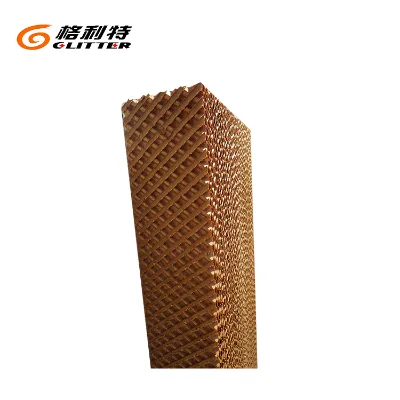
A wall mounted evaporative cooling pad works by drawing hot air through wet corrugated media, where water evaporation lowers the air temperature before it enters the space. The pad is installed vertically on a wall with a water distribution system keeping the medium saturated. Performance depends on air velocity, pad thickness, water quality, and the dryness of incoming ambient air.
What thickness options are available for wall mounted evaporative cooling pads?
Listed wall mounted evaporative cooling pads are available in a 15cm thickness, which is a common configuration for greenhouse and livestock applications. Thicker pads generally offer longer air contact time and better cooling efficiency, but require stronger fans. Confirm the exact standard size, such as 1800 by 600 by 150 millimeters, with the seller before ordering.
Which certifications should a wall mounted evaporative cooling pad have?
Commonly listed certifications for these pads include CE, ISO9001, and RoHS, and some listings reference ISO or UR approvals. Certification indicates the manufacturer follows recognized quality and safety processes, which matters for regulated installations. Always request copies of current certificates rather than relying on listing claims, and verify that the certificate scope covers the specific pad model you intend to purchase.
What is the typical service life of a wall mounted evaporative cooling pad?
Listed products reference a usable life of roughly six to eight years under normal operating conditions. Actual longevity depends heavily on water quality, maintenance frequency, and whether the system is drained and dried when idle. Hard water scaling and algae growth are the main causes of early replacement. Regular cleaning and water treatment help pads reach the upper end of that range.
Can wall mounted evaporative cooling pads be customized in size?
Yes, customization is available for listed products, and some specifications state that size can be customized to project requirements. Standard lengths such as 1200, 1800, and 2400 millimeters are offered alongside models like 7090, 5090, and 6090. When requesting customization, provide the wall opening dimensions, required airflow, and corrugation angle preference, such as 35 or 45 degrees, so suppliers quote accurately.
Which applications suit a wall mounted evaporative cooling pad?
These pads are listed for greenhouses, horticulture, animal husbandry, livestock and poultry breeding, and general industrial use. They perform best in hot, dry climates where evaporation is effective, and they are commonly paired with exhaust fans to pull air through the pad wall. For enclosed machinery spaces, low noise operation and industrial water compatibility are practical selection criteria worth confirming with the supplier.
How are wall mounted evaporative cooling pads packed for shipping?
Listed packing options include paper cartons, export cartons, plain cartons, and film wrapping. Carton packing with film protection helps prevent edge damage and media deformation during transit. Before ordering, confirm the packing method, pallet arrangement, and container loading quantities, since fragile cellulose media can be damaged if stacked incorrectly. Ask whether protective corner pieces or moisture barriers are included for long sea shipments.
What water absorption performance should these cooling pads deliver?
Listed specifications reference water absorption greater than 255 percent, meaning the media can hold more than twice its dry weight in water. Higher absorption supports even wetting across the pad face and reduces dry spots that pass uncooled air. Consistent wetting also depends on the distribution system, corrugation angle, and water flow rate. Ask suppliers how absorption is measured before comparing figures.